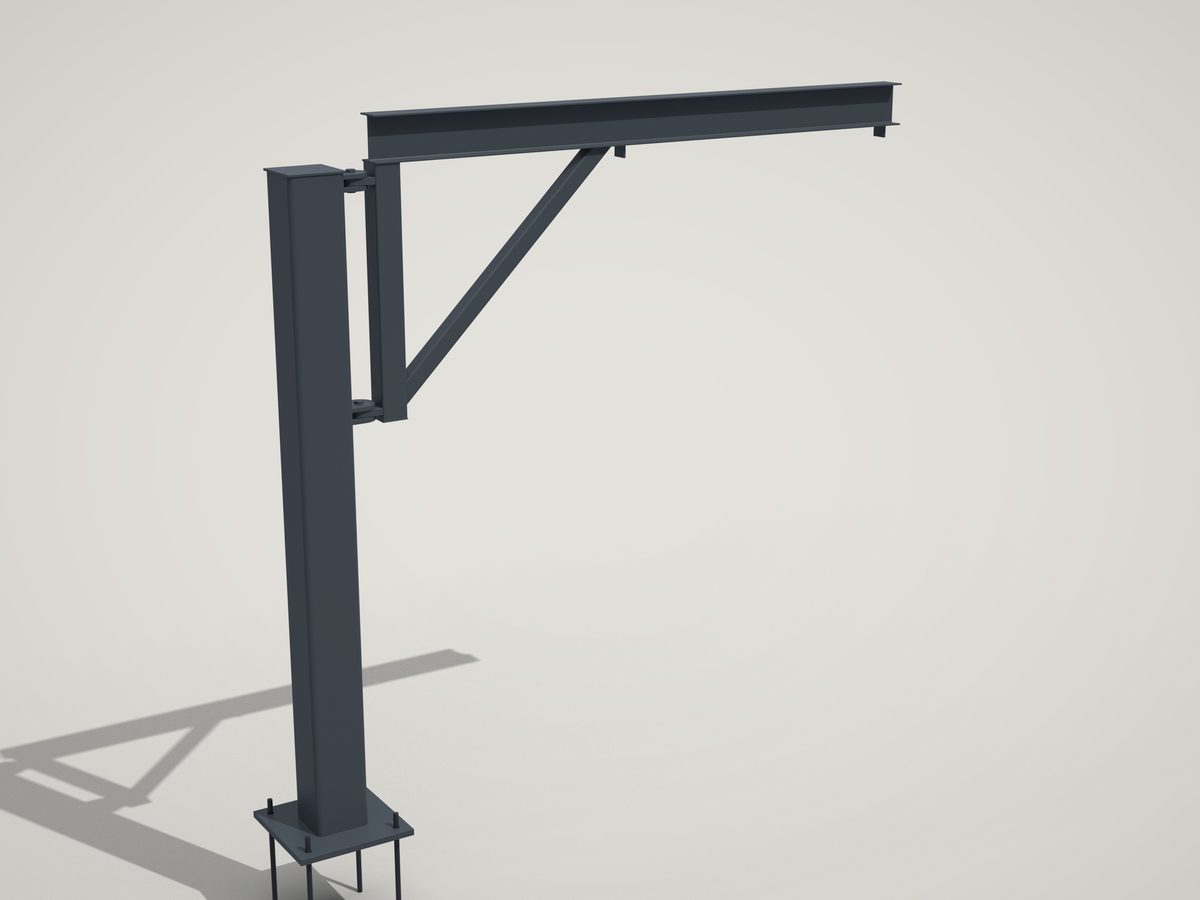
Plans/Lifting gear/Pillar jib crane
Pillar jib crane plans
A free-standing pillar jib crane for a workshop or yard: a UB arm for a beam trolley, hinged on two pins in fork brackets on a box-section pillar, bolted to a concrete pad sized against overturning. 250 kg, 500 kg and 1 t.
- Any 3 plans £12, any 5 £18Mix and match from any category: the basket works out the cheapest way.
- Lifting gear bundle: all 3 lifting gear plans £9£15 one by one. Every size of every plan.Add the bundle
- All Access: every plan £39All 134 plans now, and every new plan for 12 months.Add All Access
At checkout you tick that you want the download to start now, and that you then lose the 14-day right to cancel. If a file is faulty or not as described here, we put it right or refund you.
Drawn by a former fabricator and CSWIP 3.1 welding inspector.
Three sizes, one price
Each size is its own plan: its own cutting list, part drawings, DXFs and checks. Pick the one that fits your kit, or build more than one.
| 250 kg | 500 kg | 1 t | |
|---|---|---|---|
| Overall | 3300 x 1300 x 2878 mmacross x front to back x high | 3950 x 1600 x 3203 mmacross x front to back x high | 4650 x 2000 x 3251 mmacross x front to back x high |
| Steel in it | 266 kg | 424 kg | 674 kg |
| Steel to buy | 677 kgabout £2030 at £3 a kg, in whole stock bars: a stockist who cuts to length charges for less | 956 kgabout £2870 at £3 a kg, in whole stock bars: a stockist who cuts to length charges for less | 1442 kgabout £4320 at £3 a kg, in whole stock bars: a stockist who cuts to length charges for less |
| SWL | 250 kg anywhere from 1552 to 2500 from the pillar's centre, with a trolley and hoist rated at least that | 500 kg anywhere from 1605 to 3000 from the pillar's centre, with a trolley and hoist rated at least that | 1000 kg anywhere from 1695 to 3500 from the pillar's centre, with a trolley and hoist rated at least that |
| Height | 2700 under the arm | 3000 under the arm | 3000 under the arm |
| Slew | 104 degrees each way, by hand | 98 degrees each way, by hand | 91 degrees each way, by hand |
| Ground | firm ground, 100 kN/m2 or more; the pad 1300 x 1300 x 700 C25/30, 28 days before loading (or your engineer's cube results) | firm ground, 100 kN/m2 or more; the pad 1600 x 1600 x 800 C25/30, 28 days before loading (or your engineer's cube results) | firm ground, 100 kN/m2 or more; the pad 2000 x 2000 x 900 C25/30, 28 days before loading (or your engineer's cube results) |
| Tests | static 1.5 x SWL, dynamic 1.1 x, no permanent deformation; examined and marked before use | static 1.5 x SWL, dynamic 1.1 x, no permanent deformation; examined and marked before use | static 1.5 x SWL, dynamic 1.1 x, no permanent deformation; examined and marked before use |
| Law | Whoever builds it is its manufacturer in law (Supply of Machinery (Safety) Regulations 2008, regulation 2), even for their own use: before it lifts anything it needs a risk assessment, a technical file, a declaration of conformity and UKCA marking, as well as the tests below. Selling one carries the same duties. | Whoever builds it is its manufacturer in law (Supply of Machinery (Safety) Regulations 2008, regulation 2), even for their own use: before it lifts anything it needs a risk assessment, a technical file, a declaration of conformity and UKCA marking, as well as the tests below. Selling one carries the same duties. | Whoever builds it is its manufacturer in law (Supply of Machinery (Safety) Regulations 2008, regulation 2), even for their own use: before it lifts anything it needs a risk assessment, a technical file, a declaration of conformity and UKCA marking, as well as the tests below. Selling one carries the same duties. |
| Proof test | Static test at 1.5 x SWL (hand hoist) or 1.25 x SWL (powered hoist), and a dynamic test at 1.1 x SWL, with no permanent deformation (SM(S)R 2008 Sch 2, 4.1.2.3). | Static test at 1.5 x SWL (hand hoist) or 1.25 x SWL (powered hoist), and a dynamic test at 1.1 x SWL, with no permanent deformation (SM(S)R 2008 Sch 2, 4.1.2.3). | Static test at 1.5 x SWL (hand hoist) or 1.25 x SWL (powered hoist), and a dynamic test at 1.1 x SWL, with no permanent deformation (SM(S)R 2008 Sch 2, 4.1.2.3). |
| In use | In any business use LOLER 1998 applies: a thorough examination by a competent person before first use and every 12 months (6 months for a lifting accessory), and the SWL marked on it. | In any business use LOLER 1998 applies: a thorough examination by a competent person before first use and every 12 months (6 months for a lifting accessory), and the SWL marked on it. | In any business use LOLER 1998 applies: a thorough examination by a competent person before first use and every 12 months (6 months for a lifting accessory), and the SWL marked on it. |
Swipe the table sideways to see every size.
What is in the plan
9 A4 pages a size that print at home, every page taken off the 3D model, and a 1:1 DXF of every plate.
- Cover and limitsWhat it is, what it carries, what it is not for, and the safety basics.
- What you needWhole stock bars to buy (already nested), plates, castors and fixings, tools, a steel cost.
- Cutting listEvery piece by its letter: section, length, the cut at each end, how many.
- Bar plansHow each stock bar is cut up, so nothing is wasted and nothing is short.
- General arrangementFront, side, plan and 3D with the main sizes.
- Every part drawnEach bar with its length and end cuts, each plate with its holes set out.
- Build stepsThe model at each step with the new parts in orange, and what to do.
- DXF filesA 1:1 cutting file for every plate, ready for laser, plasma or water-jet.
Before you buy
Plans for a hobby build in a home workshop, not a certified design. What it carries and what it is not for are listed here and on page 1 of the plan.
Good for
- Lifting onto a bench, a machine or a vehicle in a workshop
- A yard or loading bay, the pad cast in firm ground
- A hand chain block or a slow electric hoist on a beam trolley
Not for
- Lifting people
- Soft, made or wet ground without an engineer's pad design
- Use before the proof test, the examination and the SWL marking
The build
Tools
- MIG welder
- Angle grinder with cutting and flap discs
- Bandsaw or cold saw
- Mag drill or pillar drill and HSS bits
- Torque wrench, tape, square, clamps, spirit level
Prime and paint, yellow by custom for lifting gear. Mark the SWL in letters at least 50 mm high on both sides of the beam.
What it was drawn for
The standard size. Each size's own figures are in the table above and on page 1 and the last page of its plan.
- SWL: 500 kg anywhere from 1605 to 3000 from the pillar's centre, with a trolley and hoist rated at least that
- Height: 3000 under the arm
- Slew: 98 degrees each way, by hand
- Ground: firm ground, 100 kN/m2 or more; the pad 1600 x 1600 x 800 C25/30, 28 days before loading (or your engineer's cube results)
- Tests: static 1.5 x SWL, dynamic 1.1 x, no permanent deformation; examined and marked before use
- Law: Whoever builds it is its manufacturer in law (Supply of Machinery (Safety) Regulations 2008, regulation 2), even for their own use: before it lifts anything it needs a risk assessment, a technical file, a declaration of conformity and UKCA marking, as well as the tests below. Selling one carries the same duties.
- Proof test: Static test at 1.5 x SWL (hand hoist) or 1.25 x SWL (powered hoist), and a dynamic test at 1.1 x SWL, with no permanent deformation (SM(S)R 2008 Sch 2, 4.1.2.3).
- In use: In any business use LOLER 1998 applies: a thorough examination by a competent person before first use and every 12 months (6 months for a lifting accessory), and the SWL marked on it.
The checks we ran
- Arm: UB 203x133x25, 1575 out from the brace, the trolley at the 3000 reach: 30 % of fy / 1.5 at SWL x 1.15 (phi2, ours), 25 % of yield at the static test at 1.5 x SWL (SM(S)R 2008 Sch 2, 4.1.2.3); lateral-torsional buckling chi 0.75 (EN 1993-1-1 6.3.2.2, length 2 x)
- Brace: SHS 80x80x5 1435 long in compression: 10 % of its buckling strength at the static test at 1.5 x SWL (SM(S)R 2008 Sch 2, 4.1.2.3)
- King post: SHS 120x120x6.3 1070 long in compression: 4 % of its buckling strength at the static test at 1.5 x SWL (SM(S)R 2008 Sch 2, 4.1.2.3)
- Hinge pins: 40 pins in double shear, 22.7 kN across each hinge at the test: 9 N/mm2 shear (fy / root 3 = 159), 19 N/mm2 bearing on the tongue (1.5 fy = 412, EN 1993-1-8 Table 3.10)
- Bottom tongue: carries 8.7 kN down onto its washer at the test, 85 out from the king post: 15 % of yield bending across its 30 thickness
- Eyes: tongues 30 thick, 60 round the 41 hole; fork plates 20 thick, 70 round it: inside the EN 1993-1-8 Table 3.9 end distances for 22.7 kN (tongue) / 11.3 kN (each fork plate)
- Pillar face: each fork plate pulls or pushes 11.3 kN on the pillar's face at the test: its face carries 120 kN (EN 1993-1-8 Table 7.11 chord face, kn 0.8 ours)
- Pillar: SHS 250x250x10 at the base: 15 % of yield at the test (24.5 kNm)
- Deflection: at the hook at SWL: 10.1 mm (pillar 5.9, arm 1.4, hinge play 2.8); reach / 250 = 12.0 (ours)
- Base plate: 30 mm plate over 90: bending 33 % of its strength at 1.5 x load, sags 0.1 mm (limit 0.6)
- Holding-down bolts: M24 8.8 cast in 490: 28.5 kN on each of the far pair at the test (bolt 203 kN, EN 1993-1-8 Table 3.4); the pair's concrete cone 322 kN for one bolt alone (EN 1992-4 7.2.1.4, k1 8.9 cast-in cracked C25/30)
- Pad: 1600 x 1600 x 800 concrete: 2.0 times the overturning at the test (1.5 min, ours); 46 kN/m2 under its edge at SWL (100 allowed: firm ground, ours - ask an engineer if the ground is soft, made or wet)
- Slew: it slews 98 degrees each way (196 in all) before the king post meets the hinge brackets
Do not
- Do not lift over the SWL, or with a trolley and hoist rated lower.
- Do not lift until the pad has cured 28 days and the crane has been proof tested, examined and marked.
- Do not side-pull or drag loads: lift straight up.
- Do not stand under the load.
The licence
Short version. The full licence is in every plan and on the licence page.
- Build as many as you like, for yourself or to sell (you are the maker of what you sell).
- Change the build for your own use.
- Do not copy, share, post or resell the files, or sell plans made from them.
- One licence is for one buyer.
Questions
What is it checked to?
The static test at 1.5 times the SWL with no permanent set (Supply of Machinery (Safety) Regulations 2008), a dynamic factor of 1.15 in the design for the load swinging at work (the 1.1 x dynamic test is a separate thing), deflection at the hook under reach / 250, pins and eyes to EN 1993-1-8, and the pad against overturning at the test load.
Who tests it?
Whoever builds it is its manufacturer in law: have it proof tested and examined by a competent person, and marked with its SWL, before it lifts anything. In any business use LOLER then needs a thorough examination every 12 months.
How far does it slew?
About 100 degrees each way, nearly 200 in all, before the king post meets the hinge brackets: stand it so that arc covers what you lift.
What do I download?
One zip: the plan in every size as an A4 PDF that prints at home, a 1:1 DXF of every plate for laser, plasma or water-jet cutting, and the licence. Nothing to install, no account.
Can I sell what I build?
Yes. The plan licence lets you build and sell the items. You are then the maker, responsible for their safety and for the rules that apply where you sell them. Lifting gear and powered gates are machinery in law: selling one, or putting one to work, needs a declaration of conformity and UKCA marking first, as their pages say. What you cannot do is share or sell the plans themselves.
Can I get a refund?
Plans are a download. At checkout you ask for the download to start straight away and confirm you then lose the 14-day right to cancel, as the plan terms set out. If a file is faulty or is not what this page describes, we put it right or refund you.
Is it an engineered design?
No. It is a set of plans for a hobby build, drawn and checked by us for the loads and limits listed on the page and in the plan. It is not a structural calculation or a certified design.
Can I have a different size?
Yes. Every plan is a 3D model: send us the sizes you want and we redraw it, re-run its checks and send the new plan.
Are the sizes metric?
All sizes are in millimetres. The steel is UK and European stock: box section to BS EN 10219, flat and round bar, plate by thickness.
More lifting gear plans
Every plan comes in its sizes, with its cutting list, part drawings and DXFs. Or the whole lot: the lifting gear bundle.
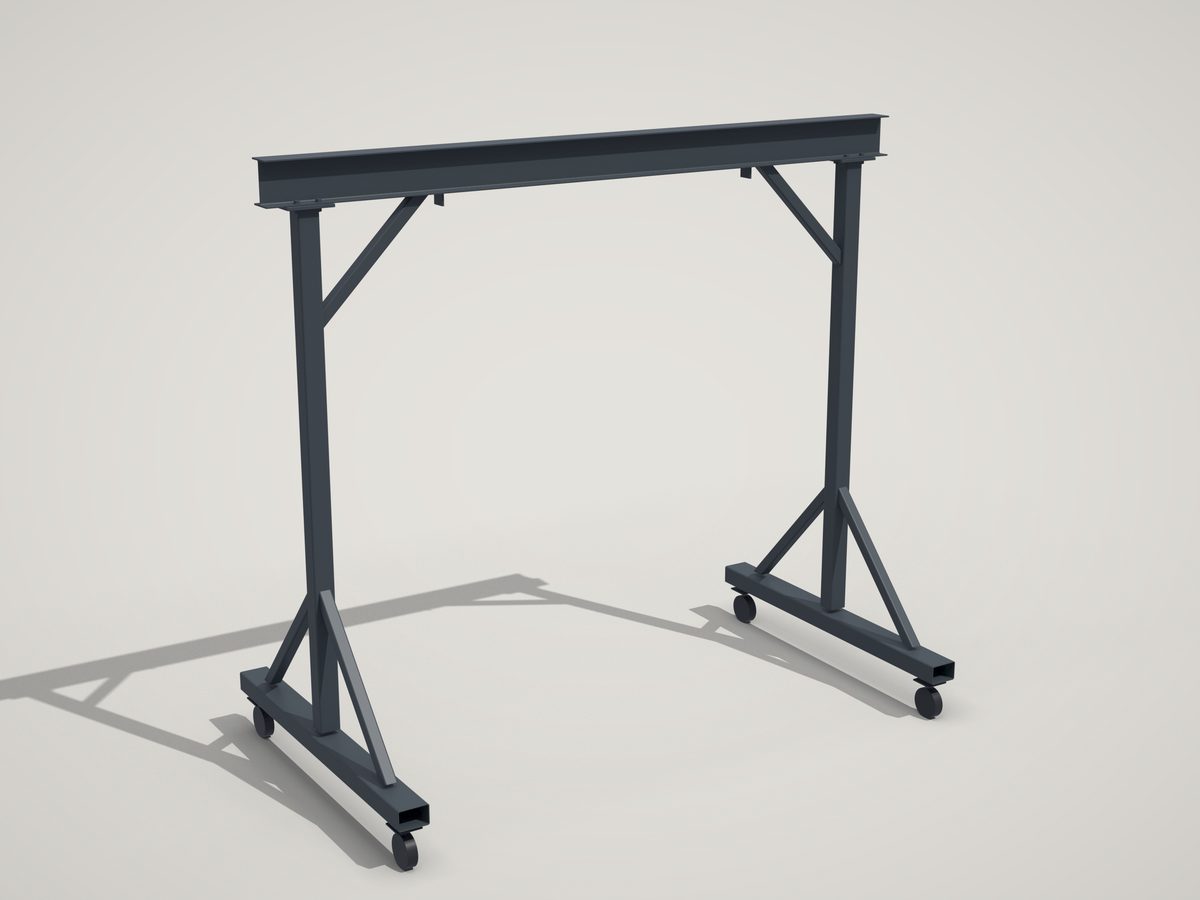
Mobile lifting gantry plans
A mobile workshop gantry: two braced post ends on braked castors and a UB beam for a trolley and hoist. 500 kg to 2 t SWL.
£53 sizes, instant download
Add
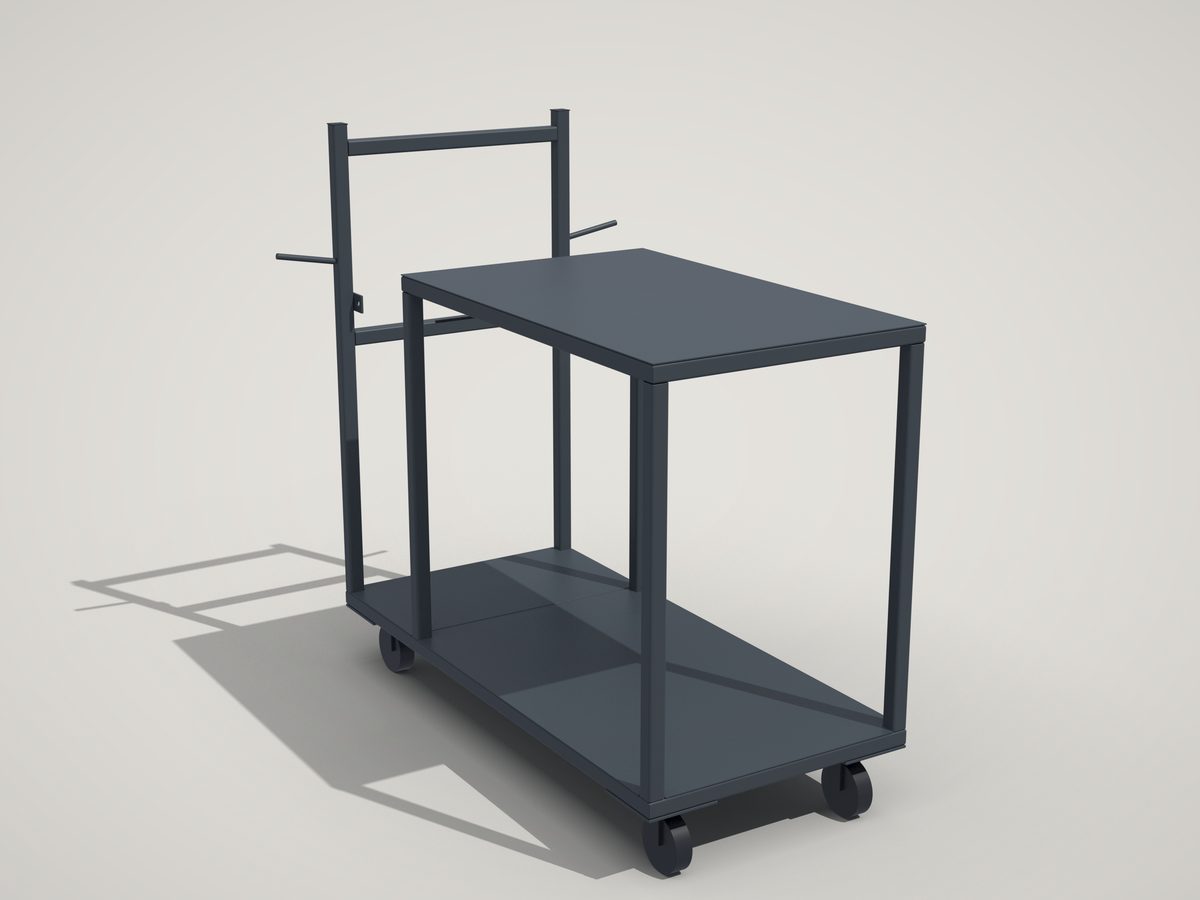
Pillar jib crane plans, all 3 sizes, £5.
Add to basketNeed another size? Send us your sizes and we redraw it.