Homes and gardens/Gates, railings and fencing/Automated swing gates
Automated swing gates
A pair of swing gates with motors on the posts, safety edges on the leaves and photocells across the opening, set out to stay inside the force limits.
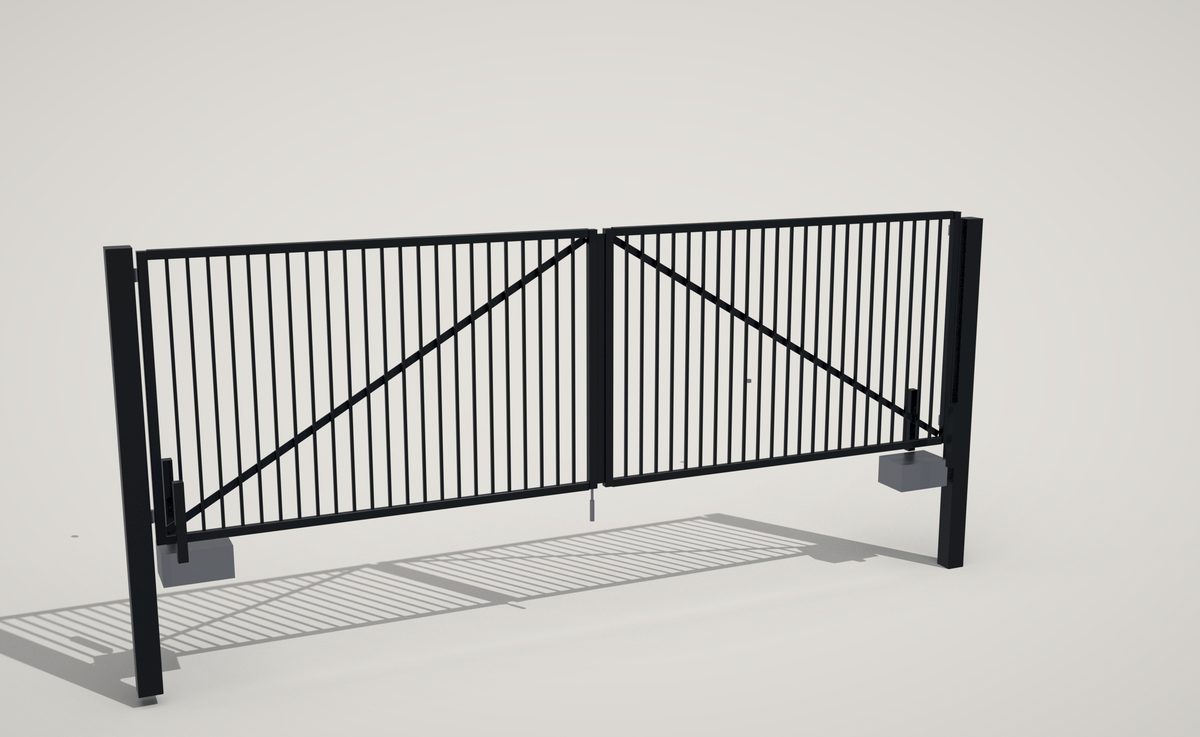
3D modelFrom sample project AL05, rendered from the model.
What it is
An automated gate is a machine, and it is tested as one: the force it can push with when it meets someone is limited and measured on site. The safety edges, photocells and settings are part of the drawing, not an afterthought.
We draw the motors, the hinges, the stops and the control positions, and leave the room the gate needs to open.
Sizes and options
As we draw it. Every size is set to your job.
| Opening | Up to about 6 m on a pair |
| Motors | On the posts, 24 V with battery back-up |
| Safety | Safety edges and photocells |
Worth knowing
An automated gate has a force limit.
Where a leaf can trap someone in a gap under 500 mm, the peak force allowed is 400 N; in open space 1,400 N, falling below 150 N within 0.75 seconds. We draw the safety devices; the installer measures the forces on site and records them.
Source: DHF TS 013-1:2021, applying BS EN 12453:2017
The detail
How it is made, fitted and priced, and what to tell us.
An automated gate is a machine, and the person who assembles it becomes its manufacturer. HSE's powered-gates guidance says that where installers assemble a gate from component parts, 'in most of these cases the converter or installer becomes the product manufacturer'. The owner keeps a duty too: the HSE says the owner or user 'should ensure that the installed product is safe, and kept safe'. So the fitter tests and signs it off, and the owner has it serviced. We draw so that testing can pass: safe gaps, safety edges and photocells in the right places, posts that can carry an operator, and room for the leaf to open.
The geometry causes most failures. The crush gap at the hinge side should stay constant, or change by no more than a fifth where it is under 100 mm. Where a leaf swings to within 500 mm of a fixed object such as a pier or wall, there is a crush hazard and it needs a safety edge or a safe distance. Our sample uses 24 V operators with battery back-up: if the mains fails, the gate still opens. A leaf cannot be stopped by a photocell alone, since light beams are a backup, never the only protection. The limits themselves are in BS EN 12453 and DHF TS 013-1; the installer tests to them with a calibrated force meter.
Wind is the sizing case, not the leaf weight. A tall louvred leaf catches the wind and the motor cannot hold it, so a ground bolt, a stop or an electric lock holds the leaf shut and the motor only moves it. Gates taller than about 2.5 m are the ones that get caught out. We show the locks, stops and ground bolts on the drawing so the installer does not add them afterwards. Underground operators hide the motor but put the leaf's load on the pivot, so we check the pivot loads before offering that route.
What changes the price: leaf length, a pair against a single, underground against post-mounted motors, the number of safety devices, access control, and ground works for cables. Tell us the opening and the leaf heights, whether the gate is inward or outward opening, what the piers or posts are made of, and the access control that goes with it. Kits and the final commissioning stay with the installer.
More views
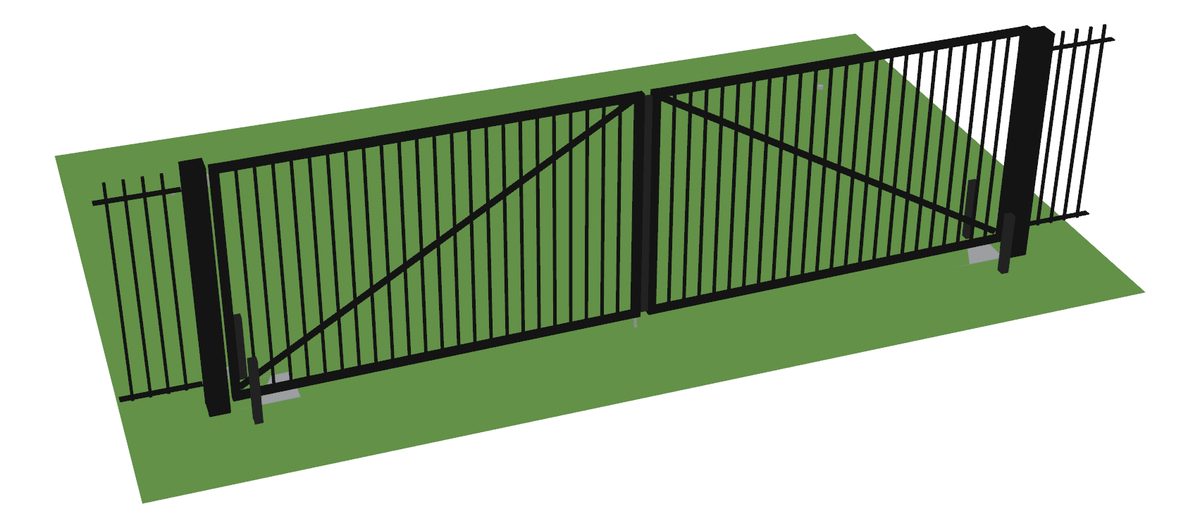
Renders and sheets from our sample projects: made-up jobs, modelled and drawn the way a real one is.
Is it right for you?
Good for
- Driveways and car parks
- Sites that need controlled access
Not for
- A gate you want a motor fitted to without testing it: the installer must test it as a machine
- Tall solid leaves in an exposed spot that no operator can hold without a lock
What the drawings show
- Plan with both swing arcs, the motor positions and the distance from the pier face to the pivot
- Elevation of the leaves with the safety edge runs along the closing edges
- Post or pier sections with the operator fixing, the hinge brackets and the wiring route
- Photocell positions and heights, with the post lines and the beam height shown
- Locks, ground bolts and stops that hold the leaves in wind
- Hinge-side and closing-side gaps dimensioned for the installer's risk assessment
Questions
Guide: Driveway gate height, opening and automationGuide: How to measure for driveway gatesGuide: How to measure for railingsGuide: How to measure for yard gates and fencingGuide: How to make a steel garden gate that hangs true
What force limits apply to an automated gate?
BS EN 12453:2017 and DHF TS 013-1 limit the force a gate can apply: 400 N where it could crush someone in a gap, and 1,400 N for impact only. The force must also drop below 150 N within 0.75 seconds. The installer measures it on site with a calibrated meter and records the result.
Who is responsible for the safety of an automated gate?
The installer, and then the owner. HSE says that where an installer assembles a powered gate from parts, the installer usually becomes the product's manufacturer. The owner or user should ensure the gate is safe and kept safe. A gate has to be checked regularly, and the installer's records are what the owner keeps.
Why do automated gates use 24 V?
A 24 V motor can keep going on a battery if the mains fails, and a lower voltage is safer for the wiring near people. Most modern swing operators are 24 V with encoder control, which senses obstructions. Our drawings default to 24 V with a battery back-up.
How wide can automated swing gates be?
Operators have a maximum leaf length and weight: typical straight-arm models are rated for leaves up to about 3 to 5 m depending on weight. A pair under about 6 m opening is typical. Beyond that, a sliding gate usually suits better. The operator maker's chart for the leaf weight sets the limit.
Can I automate my existing gates?
Sometimes. HSE guidance covers converting manual gates to power, and the converter then becomes the manufacturer. The posts must take the operator, the hinge gaps must be safe, and the leaf must be square and free. Send us the opening and a photo of the posts and we will say whether it is worth drawing.
Build it yourself
Handy with a welder? Our ready-made plans give you every part, the cutting list and the DXFs, in three sizes, checked and ready to download.
Other gates, railings and fencing
Bow-top driveway gates
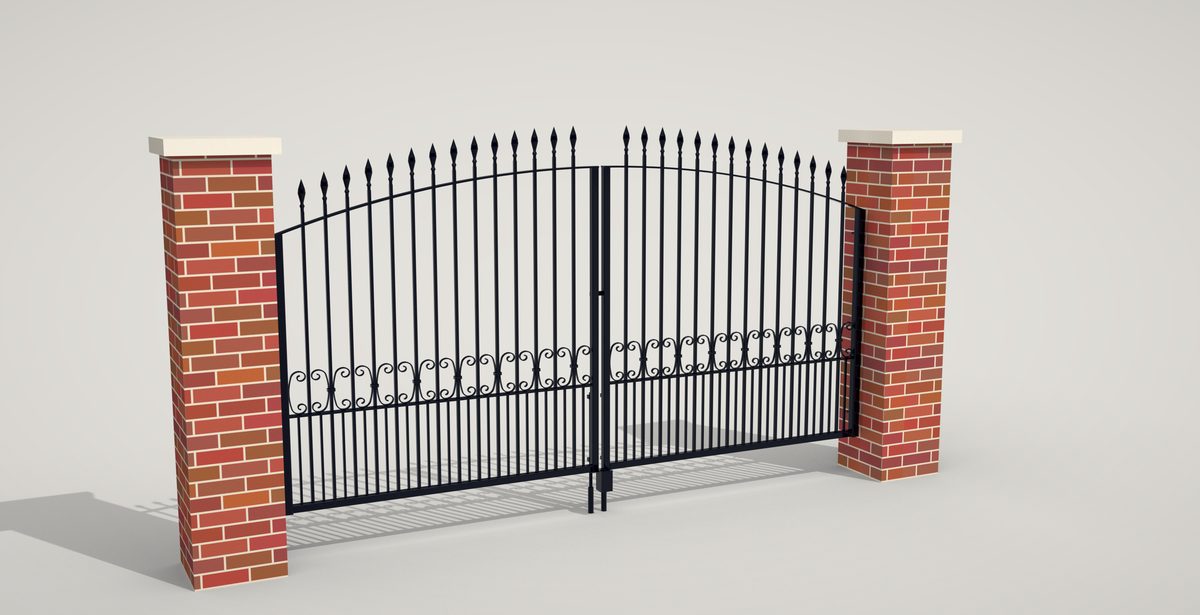
A pair of bow-top gates on brick piers, with scrolls, spears and dog bars.
From £179design pack
Garden and side gates
Single pedestrian gates for paths and side passages, flat-top or bow-top.
From £99design pack
Sliding cantilever gate
A gate that slides along the fence line on rollers, with nothing in the opening.
From £249design pack
Railings on walls
Steel railings on dwarf walls between brick piers, matching the gates.
From £179design pack
Mesh security fencing
Welded mesh panels on steel posts, stepped down slopes, with gates to match.
From £495design pack
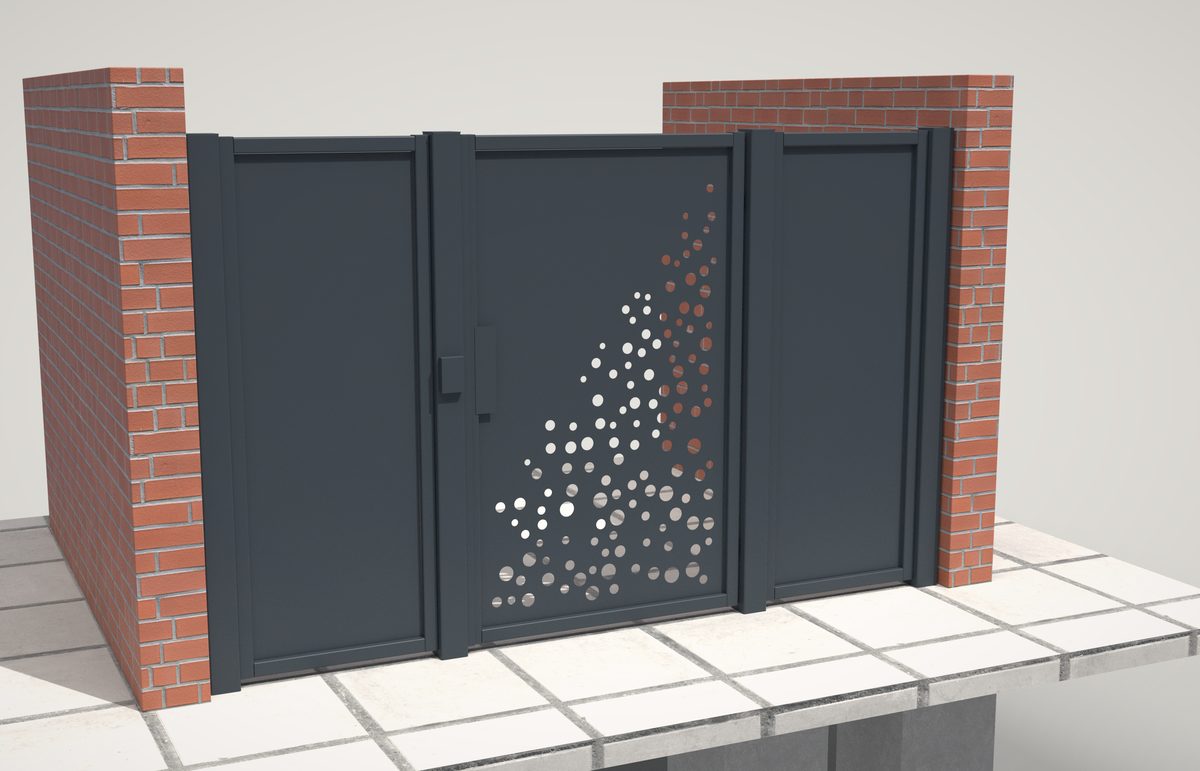
Bin stores and refuse enclosures
Railed or screened bin stores with hinged gates, fixed to the building or in their own footings.
Trade from £295approval set, fixed price
Your automated swing gates, drawn from a real 3D model.
Driveway gate design pack: from £249The design pack covers openings up to 4 m; wider gates are priced on request. Back in 3 working days or your money back. Or call 07399 358543 to ask first.